I. Introduction: More than a decade of legislative success
Few legislative initiatives have had as profound an impact on Luxembourg’s investment funds industry as the introduction of the Reserved Alternative Investment Fund (“RAIF”) by the Law of 23 July 2016 (the “RAIF Law”).
Conceived in the aftermath of the Alternative Investment Fund Managers Directive (“AIFMD”), the RAIF represented a fundamental shift in the way alternative investment funds could be structured in Luxembourg. Rather than creating another regulated investment product, the Luxembourg legislator introduced a vehicle that recognised a changing reality: for sophisticated investors, robust governance is primarily achieved through the supervision of the investment manager and the broader operational ecosystem surrounding the fund, rather than through prior approval of each individual investment vehicle.
Ten years later, that vision has proved remarkably prescient.
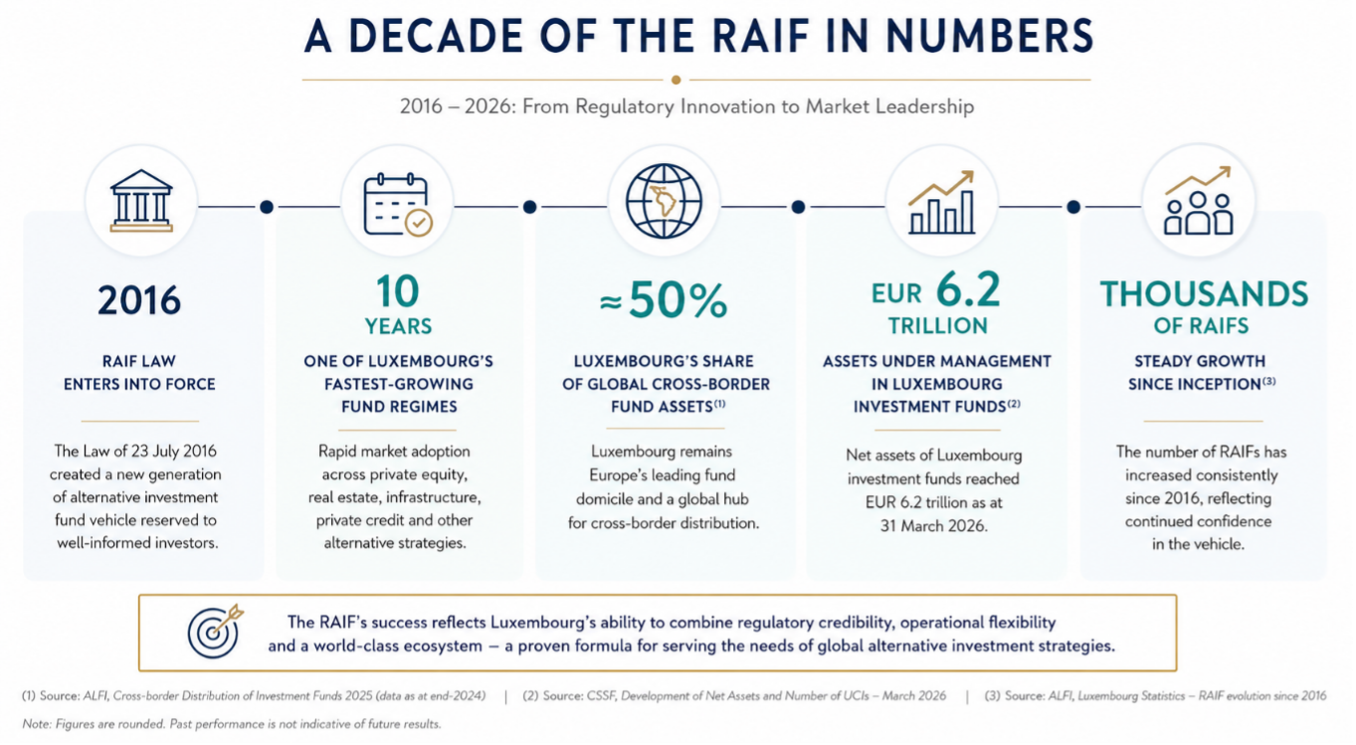
The market’s response illustrates the extent to which Luxembourg’s strategic choice has resonated with international asset managers. Luxembourg remains Europe’s leading investment fund domicile and continues to account for approximately half of global cross-border investment fund assets, reflecting the jurisdiction’s central role in international fund distribution.
The RAIF has contributed to this success. Since its introduction in 2016, the number of RAIFs has grown steadily, confirming their rapid adoption across a broad spectrum of alternative investment strategies. According to ALFI, the vehicle has established itself as one of the fastest-growing segments of Luxembourg’s alternative investment fund market.
The RAIF has become an integral component of Luxembourg’s alternative investment funds framework and is now routinely used across private equity, real estate, infrastructure, private credit, venture capital and other private market strategies. It has equally demonstrated considerable adaptability, increasingly being considered by entrepreneurial groups and family offices seeking institutional governance standards while preserving structuring flexibility.
Its success cannot be explained solely by the absence of prior CSSF approval. Nor should it be viewed simply as a faster alternative to existing regulated vehicles.
The RAIF’s enduring appeal lies in a carefully calibrated balance between flexibility and regulatory credibility. It combines the contractual freedom expected by sophisticated sponsors with the safeguards of the AIFMD framework through the mandatory appointment of an authorised Alternative Investment Fund Manager (“AIFM”) and the involvement of regulated service providers. In doing so, it reflects a broader evolution in European financial regulation: a shift away from product-centric supervision towards oversight centred on the entities responsible for investment management.
A decade after its introduction, the RAIF is no longer an innovative newcomer. It has become part of the infrastructure of Luxembourg’s alternative investment ecosystem.
This article revisits the legislative rationale behind the creation of the RAIF, analyses the regulatory philosophy that underpins its success and explores why it continues to occupy a central position in the structuring of alternative investment funds for asset managers, institutional investors and increasingly sophisticated private wealth.
II. Why Luxembourg needed the RAIF
The creation of the RAIF was not an isolated legislative initiative. It formed part of a broader transformation of the European regulatory landscape following the global financial crisis and the implementation of the AIFMD.
By introducing a harmonised regulatory framework for alternative investment fund managers, the AIFMD fundamentally altered the organisation of the European alternative investment industry. Rather than harmonising every type of alternative investment fund, the Directive focused on the prudential regulation of the manager responsible for portfolio management, risk management and investor protection.
Luxembourg implemented this framework through the Law of 12 July 2013 on Alternative Investment Fund Managers, while preserving its well-established range of domestic investment vehicles. As a result, Luxembourg sponsors continued to benefit from structures such as the Specialised Investment Fund (“SIF”) and the Investment Company in Risk Capital (“SICAR”), both of which remained subject to direct product supervision by the Commission de Surveillance du Secteur Financier (“CSSF”).
In practical terms, the RAIF borrowed many of the structuring features that had made the SIF and, for risk capital strategies, the SICAR attractive to international sponsors, while removing the requirement for prior CSSF approval at product level. Like the SIF, it offers broad investment flexibility and may be reserved to sophisticated investors; unlike the SIF and the SICAR, however, it is not itself authorised and supervised as a regulated product by the CSSF. This distinction allowed Luxembourg to preserve a familiar fund architecture while materially improving time-to-market for well-informed investors.
Although this model offered a high level of regulatory oversight, it also resulted in a dual supervisory framework. The authorised AIFM was subject to ongoing prudential supervision under the AIFMD, while the investment vehicle itself generally remained subject to prior authorisation and continuing product supervision by the CSSF.
The Luxembourg legislator identified an opportunity to modernise this approach.
The legislative preparatory works (travaux préparatoires) to the RAIF Law make clear that this dual supervision did not result from any requirement imposed by European law. Instead, it reflected Luxembourg’s domestic regulatory choices. The legislator therefore sought to introduce a new investment vehicle capable of preserving the high standards of investor protection associated with Luxembourg funds while eliminating an additional layer of product supervision that was no longer considered indispensable for well-informed investors.
The objective was not deregulation. It was regulatory efficiency.
Rather than reducing investor safeguards, the RAIF reallocates them. Regulatory oversight is exercised primarily through the authorised AIFM, which remains responsible for complying with the comprehensive organisational, operational and conduct of business requirements imposed by the AIFMD. The fund itself operates within this broader regulatory framework while remaining outside the scope of direct prudential supervision as a product by the CSSF.
This legislative choice also responded to increasingly competitive international markets.
Alternative asset managers were seeking investment vehicles capable of being established within commercially driven transaction timetables while continuing to benefit from a recognised European regulatory framework. Luxembourg’s challenge was therefore not simply to create another investment vehicle, but to reinforce its competitiveness as a leading domicile for alternative investment funds without compromising its reputation for legal certainty, governance and investor protection.
The RAIF successfully reconciled those objectives. It preserved the credibility associated with Luxembourg’s investment fund industry while offering sponsors significantly greater flexibility in establishing new investment structures.
Importantly, the RAIF was never intended to become a retail investment product. It remains reserved to “well-informed investors”, reflecting the legislator’s assessment that institutional investors, professional investors and other sufficiently experienced investors are capable of evaluating the risks associated with alternative investment strategies without requiring direct product supervision by the CSSF.
III. A regulatory innovation rather than regulatory simplification
The RAIF is frequently described as a fund that is “not supervised by the CSSF”. Although technically accurate in relation to product approval, this description risks oversimplifying one of the most significant innovations introduced by the RAIF Law.
The RAIF did not remove regulation.
It reorganised it.
Prior to 2016, Luxembourg alternative investment structures frequently combined supervision of both the investment vehicle and the investment manager. The RAIF introduced a different allocation of regulatory responsibilities, recognising that the AIFMD had already established a comprehensive supervisory framework centred on the authorised AIFM.
This distinction remains fundamental.
The authorised AIFM is responsible for portfolio management, risk management, valuation oversight, conflicts of interest, remuneration policies, transparency obligations and regulatory reporting. Depending on the characteristics of the structure, the RAIF must also appoint the service providers required under the applicable legal framework, including a depositary, a central administration and an approved statutory auditor.
Investor protection therefore results from the interaction of a comprehensive governance ecosystem rather than from direct supervision of the investment vehicle itself.
In retrospect, this approach anticipated a broader evolution within the alternative investment industry.
Institutional investors increasingly assess investment structures by reference to the quality of governance, the experience of the investment manager, operational resilience, transparency and alignment of interests. Product approval, while remaining relevant for many categories of investment funds, is no longer viewed as the sole or even the principal indicator of investor protection for sophisticated alternative investment strategies.
The RAIF reflects this reality. It acknowledges that, for well-informed investors, confidence derives less from the existence of an additional regulatory authorisation than from the quality of the regulatory framework surrounding the investment manager and the broader investment platform.
This shift in regulatory philosophy arguably represents the RAIF’s greatest contribution to Luxembourg investment fund law. Rather than weakening regulation, it demonstrated that investor protection and operational efficiency are not mutually exclusive objectives. By placing the authorised AIFM at the centre of the supervisory framework, while preserving robust governance standards and the involvement of regulated service providers, Luxembourg introduced a model that has proven both resilient and commercially successful.
Ten years later, this architecture continues to distinguish the RAIF from many competing investment vehicles and remains one of the principal reasons for its enduring relevance within the European alternative investment industry.
IV. Why the RAIF became the vehicle of choice
Legislative innovation alone does not explain the RAIF’s success. Over the past decade, the vehicle has become firmly established because it addresses the practical requirements of sponsors operating in increasingly competitive private markets.
Fundraising processes have accelerated, transactions have become more complex and investors expect institutional governance combined with efficient execution. Against this backdrop, the RAIF has emerged as a structuring solution capable of reconciling these objectives without departing from the regulatory framework established by the AIFMD.
Efficient execution in a competitive market
One of the principal attractions of the RAIF is the absence of prior product authorisation by the CSSF.
Unlike regulated fund regimes requiring approval before launch, a RAIF may generally be established once the constitutional documents have been finalised and the required service providers have been appointed. This allows sponsors to align the establishment of the vehicle more closely with commercial fundraising and transaction timelines.
For private equity sponsors, infrastructure managers and real estate investors operating in competitive acquisition processes, this operational flexibility may represent a significant advantage. It enables the legal structure to adapt to commercial opportunities rather than requiring commercial opportunities to adapt to regulatory approval processes.
This should not, however, be confused with the absence of regulation. The regulatory obligations applicable to the authorised AIFM, together with the involvement of the other required service providers, continue to provide the governance framework expected by sophisticated investors.
Flexibility across strategies and legal forms
Another distinguishing characteristic of the RAIF is its adaptability.
The vehicle may be established using a broad range of Luxembourg legal forms, including corporate entities and limited partnerships, allowing sponsors to select the governance model most appropriate for their investment strategy and investor base.
Similarly, the RAIF may operate as an umbrella structure with multiple compartments whose assets and liabilities remain legally segregated. This enables managers to accommodate different investment strategies, investor groups, geographical focuses or investment vintages within a single legal framework while maintaining operational efficiency.
Rather than imposing a single model, the RAIF provides a framework capable of adapting to the commercial realities of different alternative investment strategies.
A recognised European platform
The RAIF also benefits from being embedded within Luxembourg’s broader investment fund ecosystem.
This ecosystem has continued to expand over the past decade. According to the CSSF, Luxembourg investment funds held more than EUR 6.6 trillion in net assets as at 31 May 2026, underlining the scale and maturity of the jurisdiction’s fund industry.
The jurisdiction combines a mature legal framework with an extensive network of authorised AIFMs, depositaries, central administrators, auditors and specialist advisers. This operational infrastructure has contributed significantly to Luxembourg’s position as one of the world’s leading cross-border investment fund domiciles and provides sponsors with a high degree of familiarity among institutional investors, financing providers and international counterparties.
In practice, sponsors are not simply selecting a legal vehicle. They are choosing an ecosystem capable of supporting increasingly sophisticated investment structures throughout their lifecycle.
Beyond launch: supporting the entire investment lifecycle
The RAIF has demonstrated its ability to support investment structures well beyond their initial fundraising phase.
Over the past decade, sponsors have increasingly used RAIFs not only for flagship funds but also for parallel vehicles, co-investment arrangements, continuation funds, warehousing structures and other bespoke investment platforms designed to respond to evolving investor requirements.
Its contractual flexibility allows governance and economic arrangements to be tailored to the specific needs of each transaction while maintaining the consistency and legal certainty expected by institutional investors.
Ultimately, the market has embraced the RAIF because it is not merely quicker to establish. It provides sponsors with a flexible legal framework capable of evolving alongside increasingly sophisticated investment strategies while remaining anchored within a recognised European regulatory environment.
V. The RAIF today: Supporting the evolution of private markets
The alternative investment industry of 2026 bears little resemblance to that of 2016.
Private markets have expanded considerably beyond their traditional focus on buyout transactions and real estate investments. Institutional investors now allocate capital across infrastructure, renewable energy, private credit, venture capital, digital infrastructure and numerous other specialised strategies. At the same time, investment structures themselves have become increasingly sophisticated.
One of the RAIF’s greatest strengths has been its capacity to evolve alongside these developments. Market data also illustrates the continuing expansion of the vehicle. ALFI’s industry statistics show a sustained increase in the number of RAIFs since the regime was introduced in 2016, reflecting the vehicle’s growing acceptance among international sponsors across multiple alternative asset classes.
From flagship funds to bespoke investment platforms
While the RAIF continues to be widely used for traditional private equity and real estate funds, its application has expanded significantly over the past decade.
Sponsors now regularly use RAIFs to establish co-investment vehicles alongside flagship funds, continuation vehicles in GP-led transactions, dedicated sector-focused investment platforms, feeder structures and parallel funds designed to accommodate different categories of investors.
Rather than requiring a separate legal framework for each of these structures, the RAIF provides sufficient flexibility to support a broad range of investment solutions within a familiar Luxembourg environment.
Accommodating new investment strategies
The diversification of private markets has also broadened the range of asset classes commonly structured through RAIFs.
Infrastructure investments often require long-term governance arrangements and cross-border holding structures. Private credit strategies may involve increasingly sophisticated financing transactions. Venture capital funds require flexibility throughout successive fundraising rounds, while digital infrastructure and energy transition investments frequently combine assets located across several jurisdictions.
The RAIF’s legal framework is sufficiently adaptable to accommodate these diverse investment strategies while maintaining a consistent governance model centred on the authorised AIFM.
Governance has become a competitive advantage
Perhaps the most significant evolution over the past decade concerns investor expectations.
Institutional investors now devote considerable attention to operational due diligence, governance arrangements, conflicts management, valuation procedures, cybersecurity, sustainability-related governance and regulatory compliance. The quality of an investment platform is therefore measured not only by its investment performance but also by the robustness of its governance framework.
In this environment, the RAIF’s architecture has proved particularly resilient. By combining operational flexibility with institutional governance standards, it continues to meet the expectations of increasingly sophisticated investors without requiring fundamental legislative reform.
Its success demonstrates that flexibility and investor confidence are not opposing objectives. Properly designed governance may enhance both.
VI. Family offices: A new frontier for the RAIF?
Although the RAIF was originally conceived for professional alternative investment managers, developments within private wealth suggest that it may also offer an attractive framework for certain family office structures.
Entrepreneurial families today frequently manage diversified portfolios spanning private equity, venture capital, real estate, infrastructure, private credit and direct operating businesses across multiple jurisdictions. In many respects, their investment activities increasingly resemble those of institutional investors.
As a consequence, governance has become an increasingly important consideration.
Institutional governance for entrepreneurial capital
As family wealth becomes more international and successive generations become involved in investment decision-making, many families seek governance structures capable of balancing entrepreneurial flexibility with professional oversight.
Within the appropriate regulatory framework, the RAIF may contribute to this institutionalisation by combining a flexible investment vehicle with the governance standards associated with an authorised AIFM and Luxembourg’s broader regulated fund ecosystem.
For families whose investment activities increasingly resemble those of professional investment platforms, this may provide an appropriate framework for long-term portfolio management.
Supporting increasingly sophisticated investment programmes
Family offices also increasingly participate in co-investments alongside institutional sponsors, establish dedicated investment platforms or pursue thematic investment strategies through specialist advisers.
The flexibility offered by the RAIF may facilitate these initiatives while providing a structure that is familiar to institutional counterparties and international service providers.
Equally, the availability of umbrella structures and multiple compartments may assist families wishing to segregate investment strategies, generations or categories of assets within a single legal framework.
Not a substitute for traditional holding structures
The RAIF should nevertheless be viewed as one tool within Luxembourg’s broader structuring toolbox rather than as a universal solution.
It remains reserved to well-informed investors and must be externally managed by an authorised AIFM. Accordingly, many entrepreneurial families will continue to find that a traditional holding structure or another Luxembourg vehicle better reflects their objectives.
Where, however, a family’s investment activities have reached a degree of sophistication comparable to those of institutional investment managers, the RAIF may provide an effective framework for combining long-term capital preservation, professional governance and operational flexibility.
This evolution illustrates a broader trend within the investment industry: the increasing convergence between institutional asset management and sophisticated private wealth.
VII. Beyond the anniversary: Why the RAIF continues to matter
Anniversaries naturally invite reflection on the past. The RAIF’s tenth anniversary, however, is perhaps more significant for what it says about the future of Luxembourg’s alternative investment funds industry than for what it reveals about its origins.
The RAIF has demonstrated that regulatory efficiency and investor protection are not mutually exclusive. By placing the authorised AIFM at the centre of the supervisory framework while preserving a robust governance ecosystem, Luxembourg anticipated a broader evolution in the alternative investment industry—one in which institutional investors increasingly assess the quality of investment managers, governance arrangements and operational infrastructure rather than relying exclusively on product-level supervision.
That philosophy remains highly relevant.
Private markets continue to evolve rapidly. Fund structures have become more sophisticated, fundraising models more diverse and investor expectations increasingly demanding. Sponsors now require investment vehicles capable of accommodating continuation funds, co-investment programmes, parallel structures, private credit strategies, infrastructure platforms and increasingly complex cross-border investments without sacrificing legal certainty or operational efficiency.
Against this backdrop, the RAIF has proved remarkably resilient.
Perhaps its greatest achievement is not that it has reduced the time required to establish an investment fund. Rather, it has demonstrated that a flexible legal framework can coexist with institutional governance standards, provided that the surrounding regulatory architecture is sufficiently robust.
The RAIF’s success has therefore become inseparable from Luxembourg’s broader investment funds ecosystem. The availability of experienced authorised AIFMs, depositaries, central administrators, auditors and specialised advisers enable sponsors to establish and operate sophisticated investment structures within a jurisdiction that has earned the confidence of institutional investors worldwide.
This combination of legislation, regulatory expertise and market infrastructure remains difficult to replicate.
For asset managers considering a European platform, for institutional investors allocating capital to private markets and for entrepreneurial families seeking to institutionalise the governance of long-term investment portfolios, the RAIF continues to offer a compelling structuring solution. Its enduring relevance stems not from any single feature but from its ability to evolve alongside the industry it was designed to serve.
Ten years after its introduction, the RAIF is no longer simply another Luxembourg investment vehicle. It has become one of the defining pillars of Luxembourg’s alternative investment funds framework and a reflection of the jurisdiction’s ability to adapt its legal environment to the evolving needs of global capital markets.
Choosing the right Luxembourg investment vehicle
While the RAIF has become one of Luxembourg’s most successful alternative investment fund regimes, it is not necessarily the appropriate solution for every project.
The choice of investment vehicle should always be assessed in light of the proposed investment strategy, the targeted investor base, the desired regulatory framework, tax considerations, governance objectives and the anticipated operational model. Depending on the circumstances, a SIF, a SICAR, a Part II fund, an unregulated partnership or another Luxembourg structure may provide a more appropriate solution.
To assist asset managers, institutional investors, family offices and their advisers in navigating Luxembourg’s investment fund landscape, Chevalier & Sciales has prepared a practical Comparison Table of Luxembourg Investment Vehicles. The guide provides a side-by-side overview of the principal Luxembourg fund structures, highlighting their regulatory framework, eligible investors, legal forms, tax regime and typical use cases.
Explore our comparison table of Luxembourg investment vehicles:
https://www.cs-avocats.lu/publications/comparison-table-of-luxembourg-investment-vehicles/
As with any structuring exercise, selecting the appropriate vehicle requires careful consideration of the specific objectives of the project. Obtaining legal advice at an early stage of the structuring process remains essential to ensure that the chosen framework aligns with the sponsor’s commercial objectives, investor expectations and applicable legal and regulatory requirements.
The RAIF demonstrated that regulatory efficiency and investor protection are not mutually exclusive.
Key contacts

Key competencies
arrow_forward Private equity – Fund structuring
arrow_forward Venture capital funds
arrow_forward Real estate – Fund structuring
arrow_forward Hedge funds
arrow_forward Crypto funds
arrow_forward Private debt funds
arrow_forward Infrastructure funds
arrow_forward Sustainable finance and ESG funds
arrow_forward Regulatory and compliance
arrow_forward Restructuring and insolvency
arrow_forward Investment fund litigation